FAQs
As time is of the essence, we would like to get to work as soon as possible; of course, we are happy to fit in with the customer’s schedule. If you are unable to leave work, we are happy to do the work with no one at home; all our employees are CRB/DBS checked.
DIY damp treatments can work for minor issues and offer cost savings. However, they have limitations. Misdiagnosis, temporary solutions, potential damage, health risks, and lack of expertise are concerns. Professional damp specialists have specialised knowledge, equipment, warranties, and guarantees. For serious or persistent issues, consulting experts are advised to ensure accurate diagnosis, effective solutions, and long-term prevention.
Yes, older buildings are more vulnerable to damp issues than newer ones due to factors like outdated materials, lack of modern damp-proofing, wear and tear, less efficient ventilation, reduced insulation, historic designs, potential foundation problems, and maintenance challenges. Newer buildings are typically constructed with better materials and techniques for damp prevention. However, older buildings can still be protected by addressing vulnerabilities through maintenance and modern treatments.
Yes, damp and mould are hazardous to our health; extended exposure to mould and mildew can cause respiratory conditions. It makes sense to take action as soon as possible; call London Damp Specialists on 020 7458 4864 or fill in the form on our website.
While there are household methods of getting rid of small-scale mould we would urge you to keep in mind that For larger or persistent mould issues, it’s best to consult with our professionals to ensure proper remediation. That said, here are some steps you can take:
Ventilation and Dehumidification: Proper ventilation helps reduce moisture buildup, which is essential for mould growth. Use exhaust fans in bathrooms and kitchens and ensure good airflow throughout your home. Dehumidifiers can also help lower indoor humidity levels.
Regular Cleaning: Regularly clean and dry areas prone to moisture, such as bathrooms and kitchens. Wipe down surfaces to prevent moisture accumulation.
Baking Soda: Baking soda is a mild abrasive and can help scrub away surface mould. Mix it with water to create a paste and apply it to the affected area, then scrub gently.
Vinegar: White vinegar has natural anti-fungal properties. Spray undiluted white vinegar onto mouldy surfaces and let it sit for a while before wiping it clean.
Hydrogen Peroxide: Hydrogen peroxide is effective against mould and mildew. Use a 3% solution (typically found in most drugstores) and spray it on the mouldy area. Let it sit for 10 minutes, scrub, and wipe clean.
Tea Tree Oil: Tea tree oil is a natural fungicide. Mix a teaspoon of tea tree oil with a cup of water and spray it on mouldy surfaces. Do not rinse.
Sunlight: Sunlight helps kill mould and mildew. If possible, move mouldy items to a sunny area for a few hours.
Prevent Water Intrusion: Fix any leaks or water intrusion issues immediately to prevent moisture buildup that promotes mould growth.
Important Notes:
Safety: When using household remedies, ensure proper ventilation and wear gloves and a mask to protect yourself from mould spores.
Testing and Severe Cases: If mould covers a large area or keeps returning, it’s best to consult professionals. They can identify the extent of the problem and take appropriate actions.
Again, we cannot stress this enough– these steps are only for small-scale issues. But with serious mould infestations, we urge you to give us a call so that we can take care of it without putting the health of your household at risk as this can become a dangerous situation.***
Yes, absolutely. Here are a few options you might want to consider:
Natural Ventilation: Enhance airflow to control humidity.
Energy-Efficient Dehumidifiers: Maintain indoor moisture levels.
Plant-Based Solutions: Use oils like tea tree or neem for cleaning.
Silica Gel: Absorb excess moisture naturally.
Clay-Based Products: Environmentally friendly paints and plasters.
Recycled Materials: Incorporate damp-resistant sustainable materials.
Certified Products: Look for eco-friendly certifications.
Proper Landscaping: Prevent water accumulation around the home.
Specialist Services: Consult eco-focused damp specialists.
While some insurance providers might offer that, it would be best to check with your carrier. They will be able to provide you with a more accurate answer on this matter.
Yes, any structure can be damaged by rising damp, mould, penetrating damp, condensation, although the older the house, the more likely damp will be present. If damp is present in a new house, you should contact the builder, as you should be covered by their warranty.
Yes, damp proofing services can be carried out at any time of the year. This type of work cannot be put off, as further damage would be the result. In the event remedial work is required, the sooner it is scheduled, the better.
While it is possible to damp proof your home without professional assistance, we definitely would not recommend it, unless, of course, you have a wealth of experience and the right tools and equipment. You could end up compounding a problem and that might cost a lot of money to resolve.
At London Damp Specialists, we have a working relationship with the top insurer GPI and you can take out a policy that covers damage caused by damp.
As most home insurance policies cover damp damage, they do not cover damp proofing services, we work with a leading UK insurer called GPI and they offer a 10-year guarantee that covers damp repairs.
Yes, landscaping and drainage around your home have a significant impact on dampness. Proper slope, well-maintained gutters, effective drainage systems, and strategic vegetation placement all help prevent excess moisture from affecting your home’s foundation. These measures play a crucial role in reducing the risk of damp issues and promoting a dry living environment.
The simple answer is yes. Basement tanking in London is a very common requirement due to the moisture in the ground and there are numerous systems for waterproofing a basement/cellar.
Yes, wallpaper and paint can temporarily conceal damp issues, but they worsen over time and promote mould growth. They don’t address the underlying problem of moisture. It’s crucial to identify and fix the source of dampness for long-term solutions.
Of course, we can furnish you with references; you can see many testimonials on a leading independent review platform; there are many pages, all containing positive comments from happy customers.
Yes, at London Damp Specialists, we treat all forms of timber rot including woodworm.
As long as our team has access to all parts of the property, there is no need for you to be at home when work is being carried out. All our employees have been vetted and CRB/DBS screened.
We do not require payment until the work is dry and you are satisfied with the service.
Ensuring the success and longevity of damp treatment requires some post-treatment care on your end. Here’s what you should consider:
Ventilation: Keep rooms well-ventilated to prevent moisture buildup.
Heating: Maintain a consistent indoor temperature to prevent condensation.
Regular Cleaning: Clean surfaces to prevent mould and dust buildup.
Humidity Control: Monitor and maintain indoor humidity levels.
Prompt Repairs: Address leaks and plumbing issues promptly.
Landscape Drainage: Ensure proper landscaping for good drainage.
Inspections: Periodically check treated areas for issues.
Follow Advice: Adhere to maintenance recommendations from specialists.
Appliance Ventilation: Ensure proper ventilation for appliances.
Check External Factors: Monitor external factors that caused the issue.
Professional Checks: Schedule periodic inspections for ongoing protection.
The most important thing is that the surveyor can access all parts of the building; for a damp survey, there is no need to move furniture or indeed to protect the floor.
Basement tanking is complex work that requires all items to be removed before the work can begin.
At London Damp Specialists, we prioritise your safety and comfort. For minor treatments, there’s usually no need to vacate your home. However, in cases requiring more extensive or invasive solutions, we might recommend temporary evacuation to ensure effective treatment and your well-being. We’ll communicate clearly about the process and options, keeping you informed every step of the way. Your satisfaction and safety are our utmost concern.
Yes, any environment that is damp and humid will attract pests such as mice, rats and cockroaches. Not only that, mould is a health hazard that can lead to serious respiratory issues with extended exposure. Call London Damp Specialists on 020 7458 4864 or complete the form on your website.
Generally speaking, a home insurance policy would not cover damp proofing work; it does, however, cover the cost of repairs that are caused by damp.
Most home insurance policies do not cover remedial damp work, they do, however, cover work on damaged areas. We strongly recommend that you read the small print on a home insurance policy before taking out the cover.
Condensation forms on glass due to the temperature difference between the exterior and interior, one effective way to dissipate condensation is to open the windows, another is to generate a good airflow. Install double glazing for a permanent fix, which also saves a lot of energy.
The most important thing is to allow the surveyor access to all areas of the building; there is no need to move furniture or anything else for that matter. If you are unable to be at home at the appointed time, we are happy to carry out the inspection and all our employees are DBS/CRB checked.
We offer a range of survey services; check our homebuyer survey page for a list of services and prices. We are competitively priced and we will match any quote from a reputable company.
In our professional opinion, investing in real estate demands that you survey the property for signs of damp and mould. This is the only way to be sure that the property is damp-free.
Buying real estate is a massive investment and you should ask us at London Damp Specialists to carry out a homebuyer survey, which will reveal any damp or moisture issues. This is the only way to be 100% sure that the building is moisture free.
Purchasing a property in London is a major investment, therefore you should call us on 020 7458 4864 and arrange for one of our damp surveyors to carry out an accurate assessment. We also quote for remedial work that we recommend and our work is guaranteed for 30 years.
A leaking roof will quickly lead to timber damage; call in our damp specialists and they can fix the leak, assess the loft and check the entire house for signs of damp. Regular roof inspections are advised to be proactive and this will save on repair costs.
The short answer is yes. Any potential buyer would be happy to learn that the property has no damp issues, which is a big selling point.
We usually prepare a paper copy, plus the report is emailed to the customer and this usually happens within 24 hours. If you suspect that your home has damp issues, call us on 020 7458 4864 or fill in the form on our website.
Of course, the surveyor would be happy to read you in on the process, plus they can advise you on future projects and educate you about damp and the causes.
All forms of mould pose health risks, black mould in particular can cause serious respiration problems. If you notice a musky odour in the home, it is likely mould and mildew are present and that is a good time to call us at London Damp Specialists on 020 7458 4864 and we’ll send a surveyor to inspect the property.
You should receive the report within 24 hours of survey completion.
If you have the property surveyed for dam and mould, this is a strong selling point to add to the many attractive aspects of the package. The potential buy doesn’t have to go to the trouble of surveying for moisture, mould or damp and that might just be a deal maker!
This is caused by excess moisture and mould that thrives in a damp setting; the best solution is to contact London Damp Specialists and let our experts take a look. We are happy to quote for the required remedial work.
There are two main types of damp, namely rising damp and penetrating damp and the difference is that rising damp comes from the ground, while penetrating damp can enter a building at any location.
Homeowners can be proactive by inspecting the building on a regular basis, especially the roof and below-ground space if you have a basement. Make sure that you generate airflow, which helps to remove moisture from the air; opening windows and installing extractor fans is a good idea.
Condensation forms on the interior of the glass because two extreme temperatures meet; installing double glazing is a long-term solution, while opening windows will dissipate the moisture in the air.
Moisture causes damp and if it manages to penetrate a building, damage will surely occur. The best damp protection is to commission a damp survey from us at London Damp Specialists; the surveyor would recommend remedial work and you should have the damp proofing work done as soon as possible.
If we require furniture to be moved, we would inform you ahead of time; we provide floor protection, so there isn’t much you need to do. As long as we can access all parts of the building, we can get to work; we always leave an area as we found it, removing all waste, so there is no cleaning to do.
The main thing we need is access to the property, you do not have to move furniture for a damp survey; indeed, we are happy to carry out the inspection when the house is unoccupied, should the homeowner have other plans.
Our damp surveyors use state of the art equipment such as moisture meters, thermal imaging, borescope cameras and drone imagery. These empower the surveyor, enabling accurate results and you would receive a report within 24 hours of the survey completion.
We issue a comprehensive 30-year warranty on all our work.
A Damp Proof Course (DPC) is a construction element used in buildings to prevent moisture or dampness from rising through walls and causing damage to the structure. It’s a barrier typically installed horizontally within a wall or at the base of walls, just above ground level. The purpose of a DPC is to create a waterproof barrier that prevents groundwater, rainwater, or other forms of moisture from seeping upward through the building’s walls.
Dampness in buildings can lead to various issues such as mould growth, rot, degradation of building materials, and even health problems due to the growth of mould and mildew. DPCs are essential for maintaining the structural integrity and overall health of a building.
DPCs can be made from various materials, including:
Bitumen-based materials: These are often in the form of sheets, membranes, or coatings that are applied to the wall or inserted into the wall during construction.
Plastic sheets or membranes: These are flexible sheets made from materials like high-density polyethene (HDPE) or polyvinyl chloride (PVC).
Metallic sheets: Thin metal sheets or foils can also be used as DPCs, providing a barrier against moisture.
Chemical treatments: Special chemical compounds can be injected into walls to form a barrier against rising dampness.
DPCs are usually installed during the construction of a building, but in some cases, they can be retrofitted to existing structures to address dampness issues. The placement and effectiveness of a DPC depend on factors such as the type of construction, the local climate, and the site conditions.
Overall, a Damp Proof Course is a crucial element in building construction to prevent the detrimental effects of moisture on the building’s structure and inhabitants.
Basement tanking refers to completely waterproofing a basement, which is typically done using a cavity membrane system that prevents moisture from entering the space. It effectively seals the walls, floors and ceilings using a cavity membrane, a sump and pump to deliver water to designated drainage spots.
Damp proofing is the prevention of moisture and mould from damaging a building and in the wet, humid climate we have in the UK, damp is a very real threat. At London Damp Specialists, we offer comprehensive damp surveys for London properties.
DPC stands for ‘damp proof course’, which is a strip of plastic/bitumen that is sandwiched between courses of brickwork just above ground level. This barrier prevents moisture from moving up from the ground and affecting the walls and should it be compromised, damp will rise up into the exterior walls.
Condensation forms when there is a lot of moisture in the air and ventilation quickly removes condensation; open a few windows, especially when taking a hot bath or shower. If you cook, turn on the hood extractor until the water vapour dissipates; if your windows are old, you can replace them with double-glazing, which would end the condensation problem.
Mould and mildew are very similar; mould can generally grow on any surface, while mildew tends to be found in hidden locations. Mould is more prevalent and more dangerous than mildew.
All forms of damp are penetrative by nature; rising damp comes from the ground while penetrating damp can come from any location, including the roof. If exterior walls come in contact with water, this will likely lead to damp invading walls, as the building material draws moisture from exterior sources.
If you are thinking of buying a property in London, have the building surveyed for damp and mould and find out whether or not you have moisture issues in the house.
The best time to waterproof a basement is during initial construction, although we can carry out basement tanking in London at any time. There are numerous ways to waterproof a below- ground structure; the most common is a Type C cavity membrane system that captures and removes water.
We are a London based company and we service all London Boroughs and the Home Counties; Berkshire, Buckinghamshire, Sussex, Hampshire and Oxfordshire. We have the know-how and the resources to undertake large projects and our fully mobile surveyors are ready to assess properties.
Our employees are very responsible and will always do what it takes to finish a job and that includes working long hours in order to complete a project. We are a customer-focused company that will always go that extra mile to make our customers happy.
Of course, the foreman would give you a clear understanding of the work to be carried out, plus he would be happy to answer any questions you may have. If you are interested, they would impart their knowledge, helping you to gain a deeper understanding of what is being done, plus they can give you a few tips to prevent condensation.
Find out what our customers have to say
View all reviews on


Qualification list
PCA-Certificated Surveying
-
CSDB (Certificated Surveyor of Dampness in Buildings): This certification ensures your damp diagnosis is carried out to a recognised industry standard.
-
CSTDB (Certificated Surveyor of Timber and Dampness in Buildings): This means we can assess timber decay, wet rot, dry rot and wood-boring insect activity in the same visit, giving you a complete picture of your property’s condition
-
CSSW (Certificated Surveyor in Structural Waterproofing): Where basement or below-ground waterproofing is involved, this certification ensures that any tanking or structural waterproofing solution we recommend is specified the first time correctly.
CSCS
-
CSCS (Construction Skills Certification Scheme): Our experts carry a CSCS card, which confirms they’re authorised and trained to work safely on-site, giving you confidence that the team in your home meets recognised industry safety standards.

Asbestos awareness
-
Asbestos awareness: Older properties may contain asbestos, particularly in areas where damp and timber work are common. Our team holds UKATA-accredited Asbestos Awareness training as standard and where a job risks disturbing such materials, our experts are more than qualified to manage the work safely and in full compliance with UK regulations.

30-Year Warranty + 10-Year Insurance-Backed Guarantee
Your damp repair is protected for decades.
- 30-Year Warranty: All remediation work is covered by a 30-year workmanship warranty, protecting your property against recurrence of the treated issue.
- 10-Year Insurance-Backed Guarantee (IBG): Your guarantee is insurance-backed for 10 years through Quality Assured National Warranties (QANW), so your cover remains valid even if we’re unable to fulfil it ourselves.
- 24-Hour Report Delivery: Comprehensive digital survey reports are typically issued within 24 hours of the inspection’s completion.


Equipment Used During Our Surveys
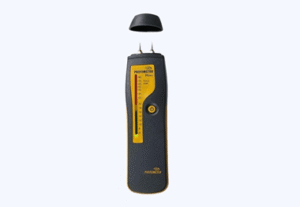
Equipment Used During Our Surveys
Purpose:
Takes comparative moisture readings from walls, ceilings, floors and timber to identify abnormal moisture patterns.
Common Uses / Notes:
Used when investigating rising damp, penetrating damp, condensation and leaks. Readings support the survey but are not a diagnosis on their own.
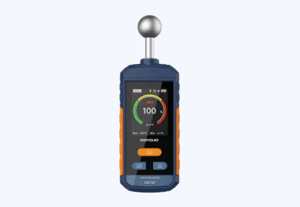
Subsurface Moisture Meter
Purpose:
Detects moisture beneath the surface of suitable building materials.
Common Uses / Notes:
Helps determine whether moisture is confined to surface finishes or extends into the building fabric.
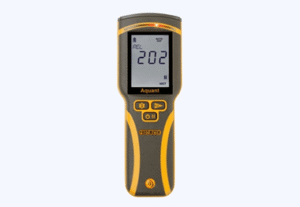
Non-Damaging Moisture Scanner
Purpose:
Scans surfaces for hidden moisture without causing damage.
Common Uses / Notes:
Ideal for decorated walls, ceilings and flooring where pin testing would be undesirable.

High-Resolution Borescope Camera
Purpose:
Inspects hidden or difficult-to-access areas without opening up large sections of the building.
Common Uses / Notes:
Used beneath floors, inside cavities, behind walls and around pipework to identify damp, leaks, decay and concealed defects.

4K Aerial Inspection Drone
Purpose:
Captures high-resolution images of roofs and other inaccessible external areas.
Common Uses / Notes:
Inspects roof coverings, chimneys, flashing, gutters, valleys, parapets and high-level masonry. Subject to weather, safety requirements and flight regulations.
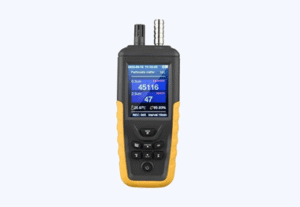
Atmospheric Humidity Sensor
Purpose:
Measures indoor relative humidity levels.
Common Uses / Notes:
Helps assess condensation and mould risk alongside temperature, ventilation, heating patterns and room usage.
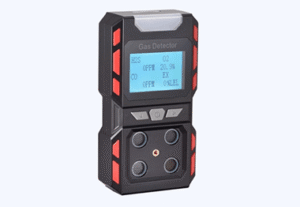
Gas Detection Monitor
Purpose:
Screens for certain airborne gases where unusual odours are present.
Common Uses / Notes:
May detect gases associated with drainage, combustion or flammable substances. Does not replace inspection by a Gas Safe registered engineer where gas appliances or pipework are involved.
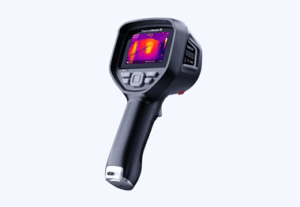
Thermal Imaging System
Purpose:
Identifies temperature differences across building surfaces.
Common Uses / Notes:
Helps locate cold spots, thermal bridging, insulation defects and areas associated with concealed moisture. Results always require further investigation to confirm the cause.
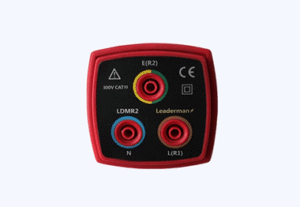
Basic Socket and RCD Tester
Purpose:
Performs limited electrical checks during comprehensive surveys.
Common Uses / Notes:
Can identify basic socket wiring issues, AC voltage and RCD operation. It is not an Electrical Installation Condition Report (EICR).
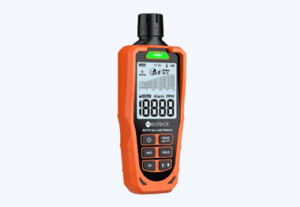
Chemical Vapour Testing Device
Purpose:
Screens for airborne volatile organic compounds (VOCs) and formaldehyde.
Common Uses / Notes:
Used where chemical odours, emissions from materials or indoor air-quality concerns are suspected after leaks or refurbishment.
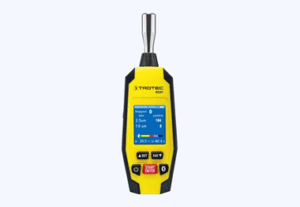
Fine Air Particle Counter
Purpose:
Measures airborne particulate matter (PM1.0, PM2.5 and PM10)
Common Uses / Notes:
Assists with investigations involving dust, smoke, mould concerns, post-construction contamination and indoor air quality following water damage.
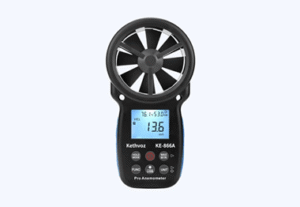
Extraction and Air-Movement Tester
Purpose:
Measures the performance of extractor fans and mechanical ventilation systems.
Common Uses / Notes:
Used in kitchens, bathrooms and utility rooms to identify poor ventilation that may contribute to condensation and mould growth.
Survey Levels and Equipment Provided
Select Your Survey
Basic Moisture Survey
Standard price: £299 + VAT
Special offer: £199 + VAT until the end of this week
The Level 1 survey provides a basic assessment of the main accessible internal surfaces. It is most appropriate for simple, localised damp concerns where advanced testing is not required.
Equipment Included
- Professional damp meter
Survey Checks
- Accessible walls
- Accessible floors
- Ceilings
- Visible plumbing and drainage leak inspection
- Damp-control and prevention information
Suitable For
This survey is suitable for a customer who has found an isolated damp patch, suspects rising damp in a limited area or wants a straightforward check of the property’s accessible surfaces.
Only a standard damp meter is included. Customers requiring deep moisture detection, timber inspection, thermal imaging or roof inspection should select a higher survey level.
The survey fee will be deducted if we carry out the recommended work.
Damp, Moisture and Timber Survey
Standard price: £399 + VAT
Special offer: £299 + VAT until the end of this week
Level 2 includes everything in the Level 1 inspection and adds deeper moisture detection, non-invasive scanning and timber assessment.
Equipment Included
- Professional damp meter
- Deep-reading moisture meter
- Non-invasive moisture scanner
Survey Checks
- Accessible walls, floors and ceilings
- Visible plumbing and drainage leak checks
- Subsurface moisture readings
- Non-invasive scanning of appropriate materials
- Accessible underfloor and subfloor checks
- Wet rot inspection
- Dry rot inspection
- Woodworm inspection
- Damp prevention information
Suitable For
This level is intended for customers who require a more detailed inspection of dampness and timber condition. It is appropriate when moisture may be concealed within building materials or beneath accessible flooring.
The survey may identify evidence of timber decay or wood-boring insects and assess moisture in locations that cannot be properly examined with a surface meter alone.
Level 2 is particularly useful for homebuyers and sellers who want more information about damp and timber before completing a transaction.
The amount paid for the survey will be deducted from repairs undertaken by us.
Full Damp and Property Condition Survey
Standard price: £499 + VAT
Special offer: £399 + VAT until the end of this week
Level 3 is our most detailed inspection. It combines the checks from Levels 1 and 2 with advanced diagnostic technology, ventilation measurements and external roof-level assessment.
Equipment Included
- Professional damp meter
- Deep-reading moisture meter
- Non-invasive moisture scanner
- Thermal imaging camera
- Indoor humidity sensor
- HD borescope camera
- Airflow and ventilation tester
- 4K inspection drone
- Socket and RCD testing device
Survey Checks
- Accessible walls, floors and ceilings
- Visible plumbing and drainage
- Deep moisture investigation
- Non-destructive moisture scanning
- Accessible floor voids and subfloors
- Wet rot, dry rot and woodworm
- Infrared thermal imaging
- Indoor relative humidity
- Extractor-fan performance
- Borescope examination where suitable
- Visible damp-proof course
- External brickwork and pointing
- Roof coverings and junctions
- Chimney stacks and flashing
- Guttering and rainwater systems
- High-level exterior areas
- General visible structural condition
- Basic Electrical Test, socket and RCD screening
- Drone photographs, subject to safe flying conditions
Suitable For
The Level 3 survey is recommended for buyers, sellers and existing owners who want the most extensive moisture assessment available.
It is especially useful for older properties, houses with several reported defects, basement buildings and cases involving damp, mould, leaks, poor ventilation, timber decay or roof problems.
The inspection considers the property as a connected building rather than examining only the visible damp patch. A roof or gutter defect, for example, may allow water to enter at a high level and appear some distance away internally.
The drone component provides valuable information about roofs, chimneys, parapets and guttering that cannot normally be seen from the ground. These areas may contain hidden repair costs capable of affecting a property purchase.
Identifying damage before buying can help the purchaser budget correctly, request further specialist advice or use the findings during negotiations. Even a relatively small roof defect may cost more to repair than the difference between the survey packages.
If we complete the recommended remedial work, your survey payment will be credited against the price.
Specialist Survey Add-On Services
For complex damp investigations, we offer three specialised laboratory and environmental testing add-ons:
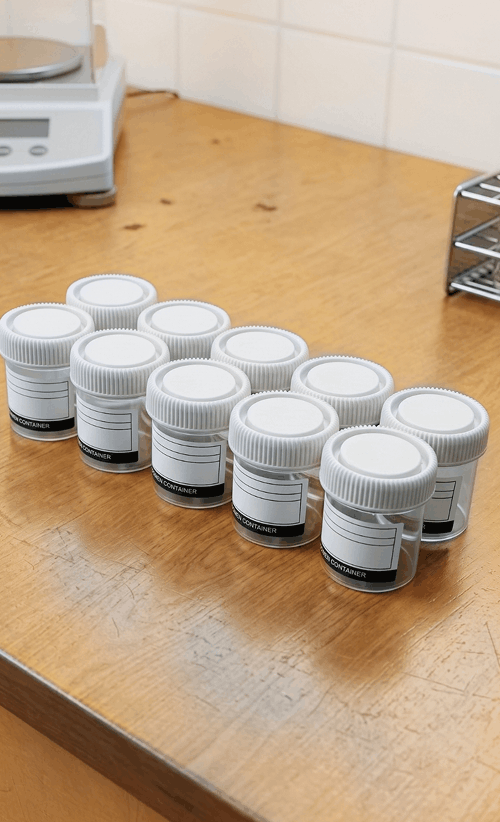
Laboratory Analysis of Plaster Samples
Price £299 + VAT
Description: Small plaster samples are extracted from affected masonry walls and submitted to an independent testing laboratory. The lab analyses the sample for hygroscopic salts (specifically nitrates and chlorides).
Value: Scientifically differentiates true rising damp (which deposits ground salts over time) from surface condensation or lateral penetrating damp. Ensures that remedial recommendations are based on chemical analysis rather than surface meter readings alone.
This service can be beneficial when:
- The cause of low-level dampness is disputed.
- Moisture-meter readings are inconsistent.
- A property has undergone previous damp-proofing.
- Old plaster continues to attract moisture.
- Independent laboratory evidence is required.
- Several possible moisture sources are present.
Note: Salt analysis is only one part of the investigation. Results must be assessed alongside the location of moisture, condition of the masonry, external ground levels, damp-proof course and potential plumbing or rainwater defects. Requires minor invasive plaster sampling (the only add-on requiring material removal). Survey fee credited when repairs are completed by us.
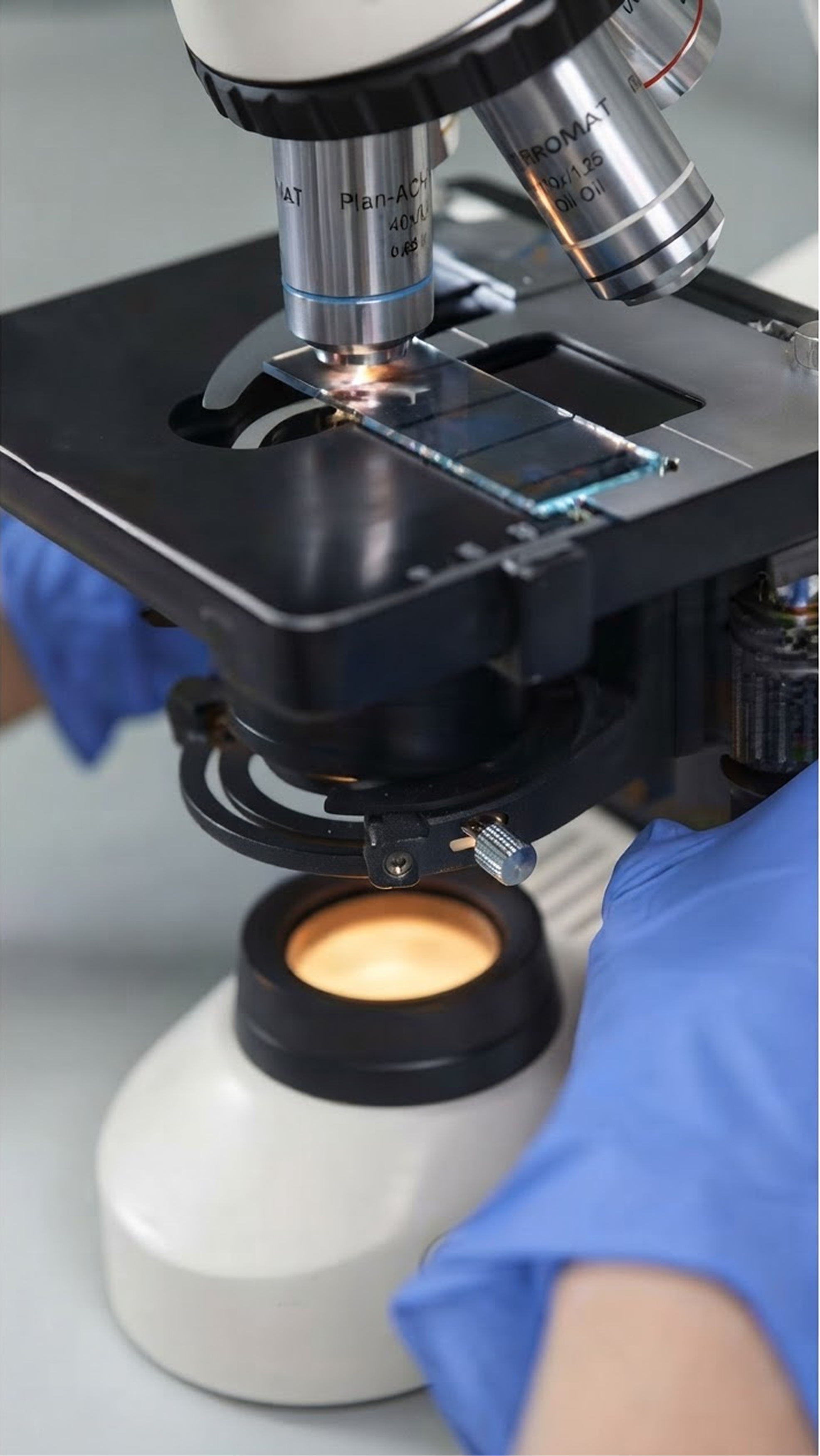
Mould Identification & qPCR DNA Testing
Price £299 + VAT
Description: Surface swab samples are collected and sent to an accredited laboratory for advanced qPCR DNA analysis. Identifies exact mould species, measures spore concentrations and detects hidden fungal growth behind furniture, within void spaces, or under floorboards.
Value: Provides precise scientific data regarding mould toxicity and contamination levels, helping establish the exact scale of cleaning, drying and structural remediation needed.
Laboratory mould testing may be useful when:
- There is an unexplained musty odour.
- Visible mould repeatedly returns.
- Water damage occurred previously.
- Mould is suspected behind cupboards or furniture.
- Contamination may be present in a concealed location.
- The visible extent of growth is uncertain.
- Independent results are needed.
- Remediation work is being planned.
Note: The results can provide a clearer indication of whether contamination appears minor, concentrated or potentially widespread. This information may be used when deciding the scale of cleaning, removal, drying or remedial work required. Testing should be combined with an investigation of the moisture source. Removing visible mould without resolving the underlying condensation, leak or ventilation problem may allow it to return. Survey fee credited against subsequent remediation works completed by us.
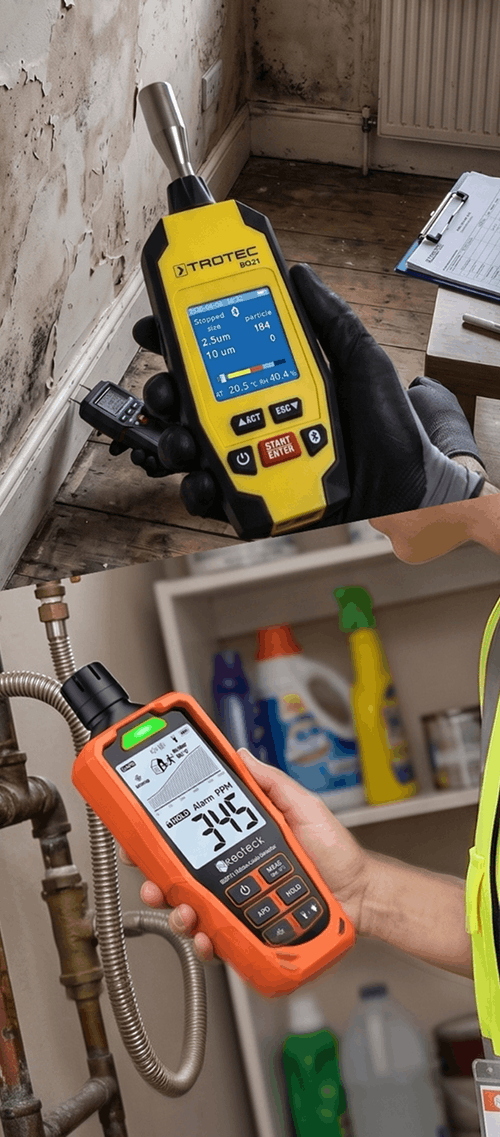
Air Quality, Gas, Vapour & Airborne Particle Screening
Price £299 + VAT
Description: Comprehensive environmental air testing including:
- Indoor environmental quality – IAQ
- Volatile organic compounds – VOC and TVOC
- Formaldehyde – HCHO
- Fine airborne particles – PM1.0, PM2.5 and PM10
- Dust and smoke particles
- Sewer gases – H2S, NH3 and CH4
- Flammable gases – CH4 and C3H8
- Carbon monoxide – CO
- Hydrogen sulphide – H2S
- Ammonia – NH3
- Oxygen measurement – O2
- Ventilation and stale-air assessment
- Drain-smell investigation
- Chemical-odour investigation
- Air checks following a leak or flood
- Combustion-related screening
- Building-material off-gassing assessment
- General airborne pollutant monitoring
Value: Pinpoints invisible airborne hazards, toxic sewer gases, chemical off-gassing and foul odours resulting from damp or trapped water.
This service can assist when investigating:
- Persistent foul smells
- Suspected sewer or drain odours
- Chemical smells
- Stale indoor air
- Odours following water damage
- Possible stagnant water
- Building material emissions
- Fine dust after construction work
- Poorly ventilated rooms
Note: Unpleasant odours can have several possible sources. Measurements for specific gases, compounds and particles may help identify which source requires further investigation. The assessment is a screening service and does not replace specialist gas-safety, environmental or medical testing where this is necessary. Survey fee credited against subsequent repair works completed by us.
Contact Us
If you have some questions, please complete this form:
Book and Pay for a survey
If you are ready to book a survey and pay, please complete this form:

Contact Us
If you have some questions, please complete this form:
Book and Pay for a survey
If you are ready to book a survey and pay, please complete this form:
Contact Us
If you have some questions, please complete this form:
Book and Pay for a survey
If you are ready to book a survey and pay, please complete this form: