
Damp Course Explained: Everything You Need to Know
A damp proof course (DPC) is a horizontal moisture barrier within walls designed to keep damp out. DPCs are typically made of strips of black plastic or bitumen material laid in the mortar joint about 150mm above ground level.
During construction, building inspectors check DPC installation to ensure full overlap where strips join and proper integration with the floor membrane for a watertight seal. The existing DPC level also provides a fixed point of reference when taking measurements for extensions.
What are Vertical DPCs?
Vertical DPCs are installed in some cases to prevent damp transfer horizontally. These are often used where garden walls join the house walls. DPCs are also built into chimney bases and parapet walls to prevent downward moisture seepage into lofts and upper floors.
Cavity trays with DPC materials are used over window and door openings. Timber windows and door frames may also have a DPC for extra protection.
Why DPCs are Important for Preventing Damp
DPCs became a legal requirement in 1875 because many construction materials like brick and concrete are porous. This porosity allows water to be absorbed from the ground upwards through capillary action. DPCs cut off this moisture source.
Originally, DPCs were slate courses. Later materials included lead, bitumen and modern hydrophobic engineering bricks. It’s rare for properly installed modern DPCs to fail and lead to damp issues.
Older Homes Most at Risk of DPC Failure
Older homes with solid walls are most prone to DPC failure and associated damp problems. Victorian houses with timber ground floors are especially vulnerable, as constant damp allows fungal decay and wood boring insects to damage joists and cause collapse. Concrete floors are less affected structurally but damp is still inconvenient.
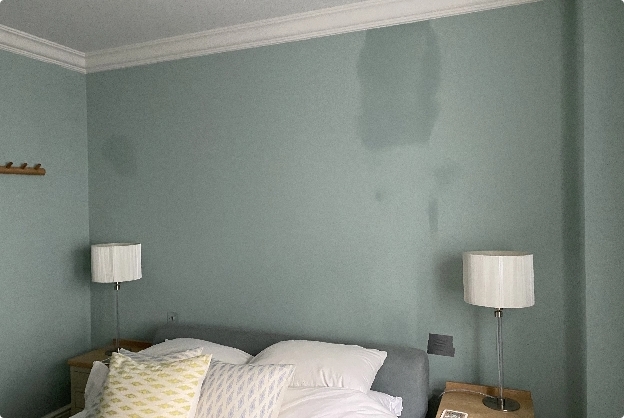
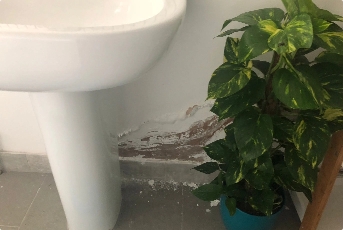
In older homes, porous brick and mortar allow damp to penetrate if the DPC has been bridged or compromised. Signs include:
- Staining on lower wall surfaces
- Rotting skirting boards
- Structural damage to floor joists
Issues with Retrofitted DPCs
Many older homes have had chemical DPCs injected but these often don’t solve the problem. Holes are drilled into mortar courses and silicone fluids injected to form a barrier. However, shoddy workmanship means they’re often too high to protect timbers or injected into brick rather than mortar, leaving moisture pathways.
They rarely work in thick stone walls. It’s best to get an independent survey rather than relying on free advice from companies selling retrofit DPCs.
What to Do if Your DPC Has Failed
Before assuming DPC failure, first tackle external water sources:
- Divert rainwater runoff away from walls
- Fix leaking gutters
- Reduce high ground levels causing ‘rising damp’
Removing cement render or flower beds bridging the DPC can help. With the water source dealt with, walls can naturally dry through evaporation.
Traditional lime plasters allow walls to breathe and dissipate residual damp. Along with ventilation and re-plastering affected areas, this often fixes damp without DPC modifications.
Surface condensation and damp can also be managed with dehumidifiers. But addressing the underlying cause is essential for long term solutions.
When to Consider Professional Damp Solutions
If improving drainage, removing bridging materials and increasing ventilation doesn’t resolve persistent damp, it may be worth consulting a damp specialist for further advice. They can assess if installation faults, deterioration or bridging is causing your DPC to fail.
Equipment Used During Our Surveys
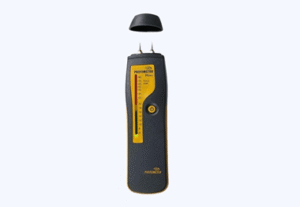
Equipment Used During Our Surveys
Purpose:
Takes comparative moisture readings from walls, ceilings, floors and timber to identify abnormal moisture patterns.
Common Uses / Notes:
Used when investigating rising damp, penetrating damp, condensation and leaks. Readings support the survey but are not a diagnosis on their own.
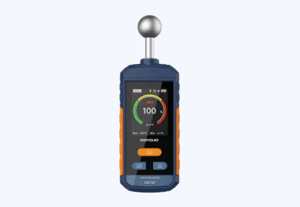
Subsurface Moisture Meter
Purpose:
Detects moisture beneath the surface of suitable building materials.
Common Uses / Notes:
Helps determine whether moisture is confined to surface finishes or extends into the building fabric.
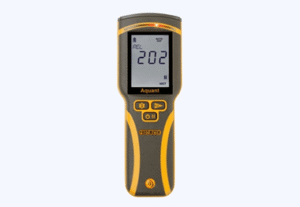
Non-Damaging Moisture Scanner
Purpose:
Scans surfaces for hidden moisture without causing damage.
Common Uses / Notes:
Ideal for decorated walls, ceilings and flooring where pin testing would be undesirable.
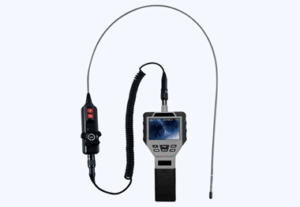
High-Resolution Borescope Camera
Purpose:
Inspects hidden or difficult-to-access areas without opening up large sections of the building.
Common Uses / Notes:
Used beneath floors, inside cavities, behind walls and around pipework to identify damp, leaks, decay and concealed defects.
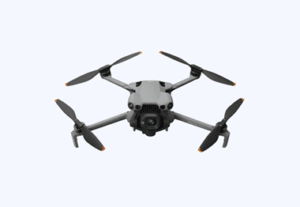
4K Aerial Inspection Drone
Purpose:
Captures high-resolution images of roofs and other inaccessible external areas.
Common Uses / Notes:
Inspects roof coverings, chimneys, flashing, gutters, valleys, parapets and high-level masonry. Subject to weather, safety requirements and flight regulations.
Atmospheric Humidity Sensor
Purpose:
Measures indoor relative humidity levels.
Common Uses / Notes:
Helps assess condensation and mould risk alongside temperature, ventilation, heating patterns and room usage.
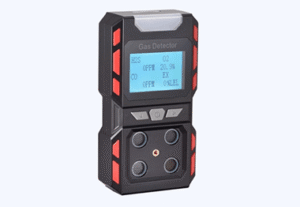
Gas Detection Monitor
Purpose:
Screens for certain airborne gases where unusual odours are present.
Common Uses / Notes:
May detect gases associated with drainage, combustion or flammable substances. Does not replace inspection by a Gas Safe registered engineer where gas appliances or pipework are involved.
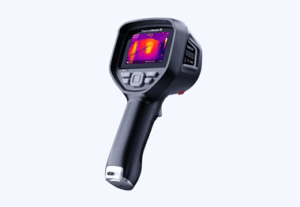
Thermal Imaging System
Purpose:
Identifies temperature differences across building surfaces.
Common Uses / Notes:
Helps locate cold spots, thermal bridging, insulation defects and areas associated with concealed moisture. Results always require further investigation to confirm the cause.
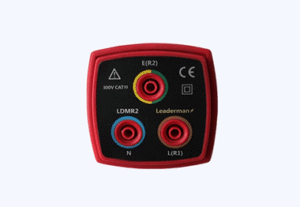
Basic Socket and RCD Tester
Purpose:
Performs limited electrical checks during comprehensive surveys.
Common Uses / Notes:
Can identify basic socket wiring issues, AC voltage and RCD operation. It is not an Electrical Installation Condition Report (EICR).
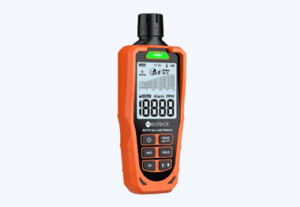
Chemical Vapour Testing Device
Purpose:
Screens for airborne volatile organic compounds (VOCs) and formaldehyde.
Common Uses / Notes:
Used where chemical odours, emissions from materials or indoor air-quality concerns are suspected after leaks or refurbishment.
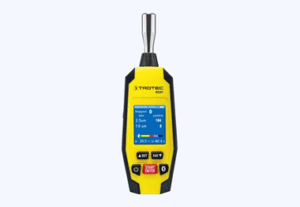
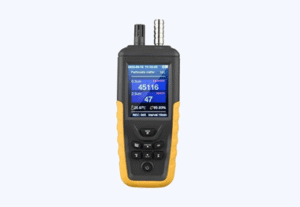
Fine Air Particle Counter
Purpose:
Measures airborne particulate matter (PM1.0, PM2.5 and PM10)
Common Uses / Notes:
Assists with investigations involving dust, smoke, mould concerns, post-construction contamination and indoor air quality following water damage.
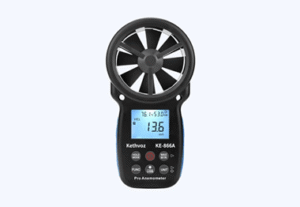
Extraction and Air-Movement Tester
Purpose:
Measures the performance of extractor fans and mechanical ventilation systems.
Common Uses / Notes:
Used in kitchens, bathrooms and utility rooms to identify poor ventilation that may contribute to condensation and mould growth.
Survey Levels and Equipment Provided
Select Your Survey
Basic Moisture Survey
Standard price: £299 + VAT
Special offer: £199 + VAT until the end of this week
The Level 1 survey provides a basic assessment of the main accessible internal surfaces. It is most appropriate for simple, localised damp concerns where advanced testing is not required.
Equipment Included
- Professional damp meter
Survey Checks
- Accessible walls
- Accessible floors
- Ceilings
- Visible plumbing and drainage leak inspection
- Damp-control and prevention information
Suitable For
This survey is suitable for a customer who has found an isolated damp patch, suspects rising damp in a limited area or wants a straightforward check of the property’s accessible surfaces.
Only a standard damp meter is included. Customers requiring deep moisture detection, timber inspection, thermal imaging or roof inspection should select a higher survey level.
The survey fee will be deducted if we carry out the recommended work.
Damp, Moisture and Timber Survey
Standard price: £399 + VAT
Special offer: £299 + VAT until the end of this week
Level 2 includes everything in the Level 1 inspection and adds deeper moisture detection, non-invasive scanning and timber assessment.
Equipment Included
- Professional damp meter
- Deep-reading moisture meter
- Non-invasive moisture scanner
Survey Checks
- Accessible walls, floors and ceilings
- Visible plumbing and drainage leak checks
- Subsurface moisture readings
- Non-invasive scanning of appropriate materials
- Accessible underfloor and subfloor checks
- Wet rot inspection
- Dry rot inspection
- Woodworm inspection
- Damp prevention information
Suitable For
This level is intended for customers who require a more detailed inspection of dampness and timber condition. It is appropriate when moisture may be concealed within building materials or beneath accessible flooring.
The survey may identify evidence of timber decay or wood-boring insects and assess moisture in locations that cannot be properly examined with a surface meter alone.
Level 2 is particularly useful for homebuyers and sellers who want more information about damp and timber before completing a transaction.
The amount paid for the survey will be deducted from repairs undertaken by us.
Full Damp and Property Condition Survey
Standard price: £499 + VAT
Special offer: £399 + VAT until the end of this week
Level 3 is our most detailed inspection. It combines the checks from Levels 1 and 2 with advanced diagnostic technology, ventilation measurements and external roof-level assessment.
Equipment Included
- Professional damp meter
- Deep-reading moisture meter
- Non-invasive moisture scanner
- Thermal imaging camera
- Indoor humidity sensor
- HD borescope camera
- Airflow and ventilation tester
- 4K inspection drone
- Socket and RCD testing device
Survey Checks
- Accessible walls, floors and ceilings
- Visible plumbing and drainage
- Deep moisture investigation
- Non-destructive moisture scanning
- Accessible floor voids and subfloors
- Wet rot, dry rot and woodworm
- Infrared thermal imaging
- Indoor relative humidity
- Extractor-fan performance
- Borescope examination where suitable
- Visible damp-proof course
- External brickwork and pointing
- Roof coverings and junctions
- Chimney stacks and flashing
- Guttering and rainwater systems
- High-level exterior areas
- General visible structural condition
- Basic Electrical Test, socket and RCD screening
- Drone photographs, subject to safe flying conditions
Suitable For
The Level 3 survey is recommended for buyers, sellers and existing owners who want the most extensive moisture assessment available.
It is especially useful for older properties, houses with several reported defects, basement buildings and cases involving damp, mould, leaks, poor ventilation, timber decay or roof problems.
The inspection considers the property as a connected building rather than examining only the visible damp patch. A roof or gutter defect, for example, may allow water to enter at a high level and appear some distance away internally.
The drone component provides valuable information about roofs, chimneys, parapets and guttering that cannot normally be seen from the ground. These areas may contain hidden repair costs capable of affecting a property purchase.
Identifying damage before buying can help the purchaser budget correctly, request further specialist advice or use the findings during negotiations. Even a relatively small roof defect may cost more to repair than the difference between the survey packages.
If we complete the recommended remedial work, your survey payment will be credited against the price.
Specialist Survey Add-On Services
For complex damp investigations, we offer three specialised laboratory and environmental testing add-ons:
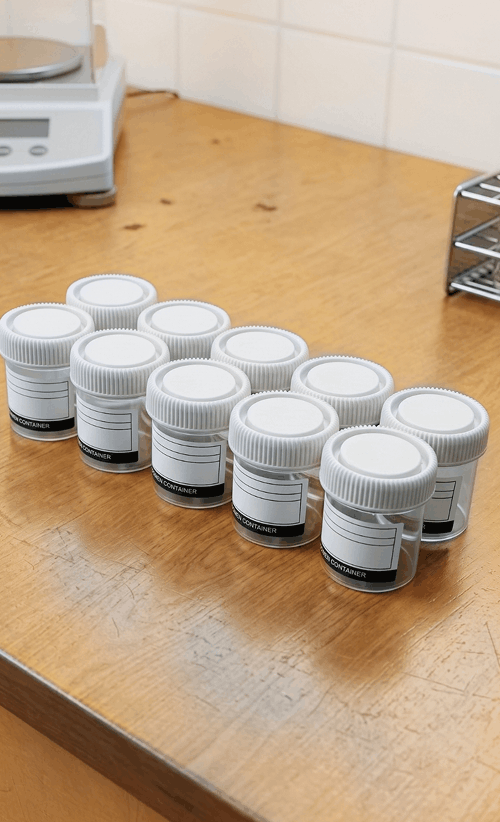
Laboratory Analysis of Plaster Samples
Price £299 + VAT
Description: Small plaster samples are extracted from affected masonry walls and submitted to an independent testing laboratory. The lab analyses the sample for hygroscopic salts (specifically nitrates and chlorides).
Value: Scientifically differentiates true rising damp (which deposits ground salts over time) from surface condensation or lateral penetrating damp. Ensures that remedial recommendations are based on chemical analysis rather than surface meter readings alone.
This service can be beneficial when:
- The cause of low-level dampness is disputed.
- Moisture-meter readings are inconsistent.
- A property has undergone previous damp-proofing.
- Old plaster continues to attract moisture.
- Independent laboratory evidence is required.
- Several possible moisture sources are present.
Note: Salt analysis is only one part of the investigation. Results must be assessed alongside the location of moisture, condition of the masonry, external ground levels, damp-proof course and potential plumbing or rainwater defects. Requires minor invasive plaster sampling (the only add-on requiring material removal). Survey fee credited when repairs are completed by us.
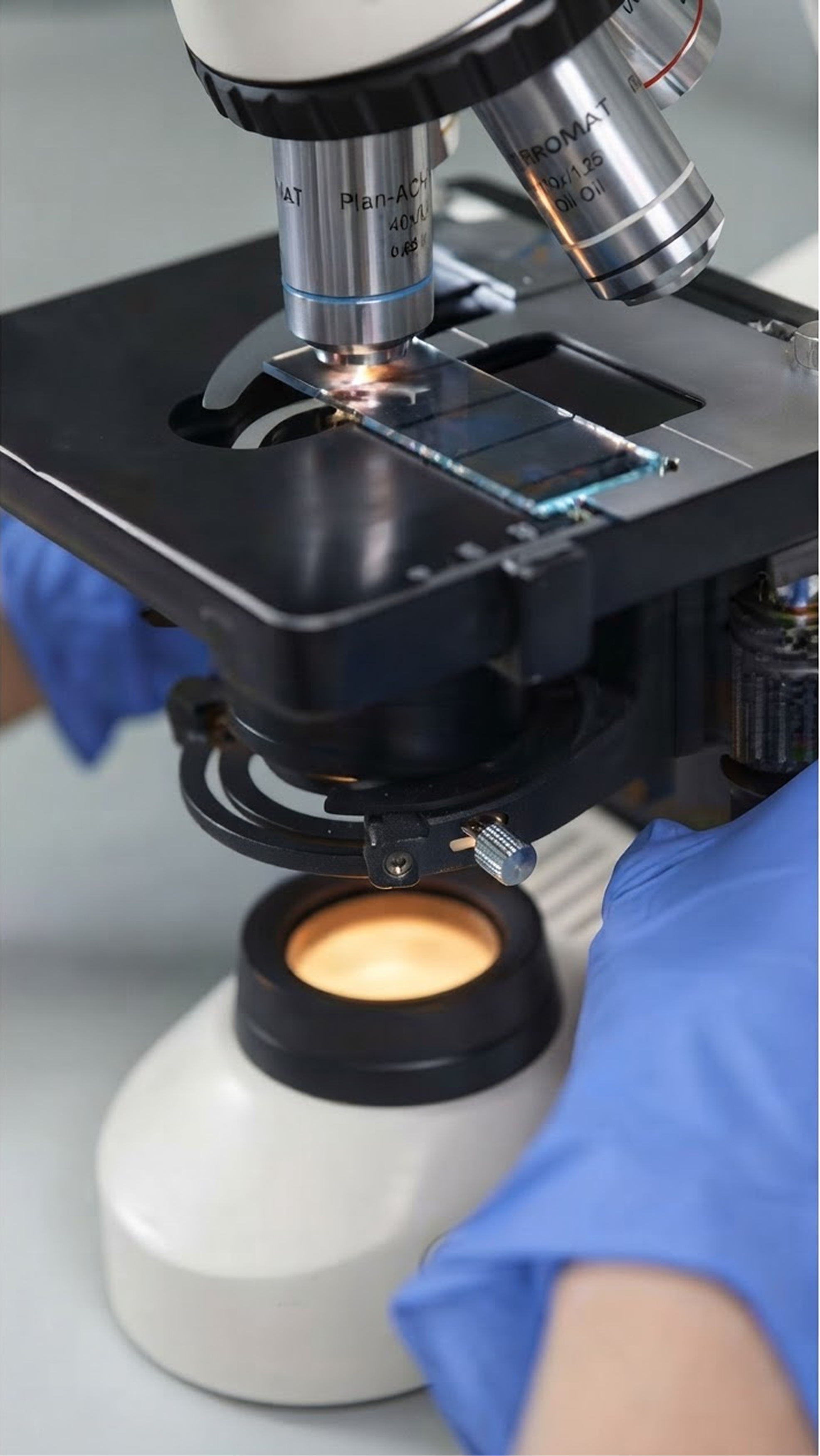
Mould Identification & qPCR DNA Testing
Price £299 + VAT
Description: Surface swab samples are collected and sent to an accredited laboratory for advanced qPCR DNA analysis. Identifies exact mould species, measures spore concentrations and detects hidden fungal growth behind furniture, within void spaces, or under floorboards.
Value: Provides precise scientific data regarding mould toxicity and contamination levels, helping establish the exact scale of cleaning, drying and structural remediation needed.
Laboratory mould testing may be useful when:
- There is an unexplained musty odour.
- Visible mould repeatedly returns.
- Water damage occurred previously.
- Mould is suspected behind cupboards or furniture.
- Contamination may be present in a concealed location.
- The visible extent of growth is uncertain.
- Independent results are needed.
- Remediation work is being planned.
Note: The results can provide a clearer indication of whether contamination appears minor, concentrated or potentially widespread. This information may be used when deciding the scale of cleaning, removal, drying or remedial work required. Testing should be combined with an investigation of the moisture source. Removing visible mould without resolving the underlying condensation, leak or ventilation problem may allow it to return. Survey fee credited against subsequent remediation works completed by us.
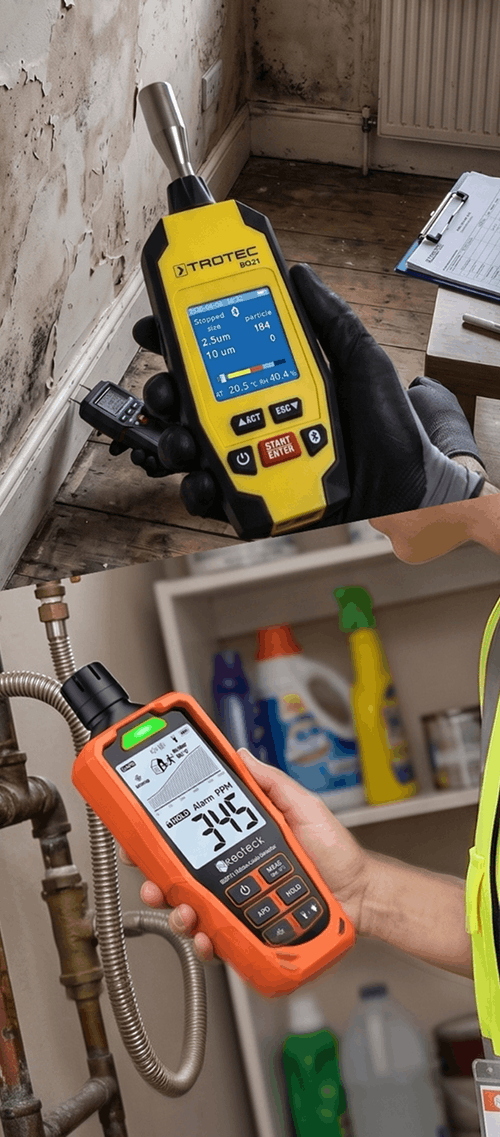
Air Quality, Gas, Vapour & Airborne Particle Screening
Price £299 + VAT
Description: Comprehensive environmental air testing including:
- Indoor environmental quality – IAQ
- Volatile organic compounds – VOC and TVOC
- Formaldehyde – HCHO
- Fine airborne particles – PM1.0, PM2.5 and PM10
- Dust and smoke particles
- Sewer gases – H2S, NH3 and CH4
- Flammable gases – CH4 and C3H8
- Carbon monoxide – CO
- Hydrogen sulphide – H2S
- Ammonia – NH3
- Oxygen measurement – O2
- Ventilation and stale-air assessment
- Drain-smell investigation
- Chemical-odour investigation
- Air checks following a leak or flood
- Combustion-related screening
- Building-material off-gassing assessment
- General airborne pollutant monitoring
Value: Pinpoints invisible airborne hazards, toxic sewer gases, chemical off-gassing and foul odours resulting from damp or trapped water.
This service can assist when investigating:
- Persistent foul smells
- Suspected sewer or drain odours
- Chemical smells
- Stale indoor air
- Odours following water damage
- Possible stagnant water
- Building material emissions
- Fine dust after construction work
- Poorly ventilated rooms
Note: Unpleasant odours can have several possible sources. Measurements for specific gases, compounds and particles may help identify which source requires further investigation. The assessment is a screening service and does not replace specialist gas-safety, environmental or medical testing where this is necessary. Survey fee credited against subsequent repair works completed by us.
Contact Us
If you have some questions, please complete this form:
Book and Pay for a survey
If you are ready to book a survey and pay, please complete this form:

Contact Us
If you have some questions, please complete this form:
Book and Pay for a survey
If you are ready to book a survey and pay, please complete this form:
Contact Us
If you have some questions, please complete this form:
Book and Pay for a survey
If you are ready to book a survey and pay, please complete this form: